

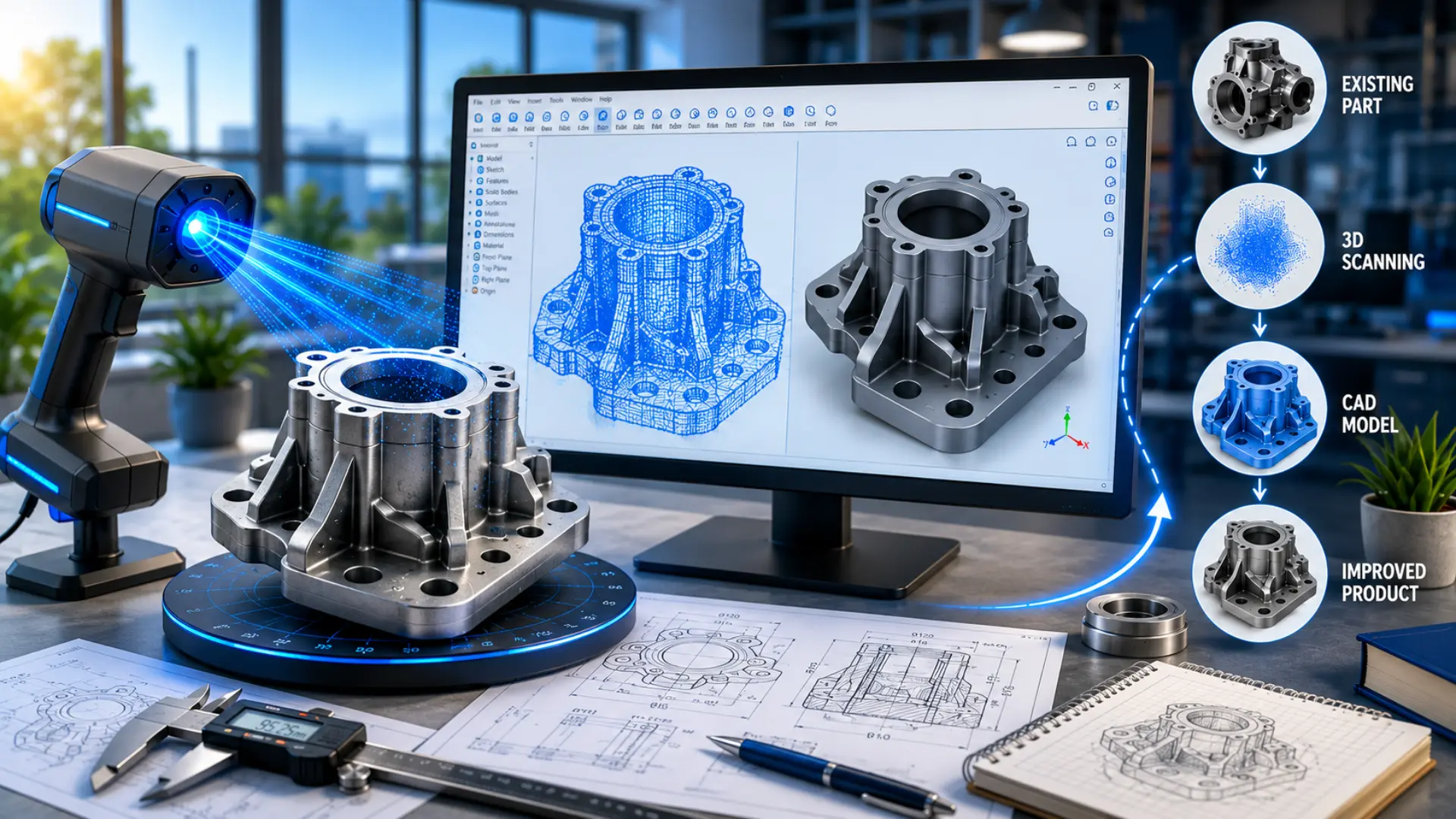
Product teams face constant pressure to launch faster, cut costs, and fix design flaws before they reach the market. Reverse engineering gives engineers a practical way to meet all three goals at once. By scanning an existing part, mechanical teams rebuild accurate digital models, study hidden geometry, and improve designs without starting from zero. Companies that offer professional Reverse Engineering Services help manufacturers turn physical parts into usable CAD data quickly. This process saves time, reduces guesswork, and gives engineers a solid foundation to build better products.
What Is Reverse Engineering in Mechanical Design?
Reverse engineering means taking an existing physical object and working backward to understand how it was built. Engineers scan the part, capture its exact shape, and convert that data into a 3D CAD model. This model shows dimensions, tolerances, and material properties that the original design files may have lost or never had. Mechanical teams use this approach when original drawings go missing, when a supplier discontinues a part, or when they need to improve an outdated design. Instead of measuring every surface by hand, engineers rely on digital tools to capture accurate data within hours instead of weeks.
The Data: What Reverse Engineering Actually Delivers
The time and cost savings from scan-based reverse engineering aren’t just anecdotal – they show up clearly in vendor benchmarks and case studies:
- 3D scanning can reduce the analysis and design validation portion of reverse engineering by up to 80% compared with traditional manual measurement methods (FARO).
- One documented case of a manufacturer and distributor of construction machine spare parts saved 85% in time and cost after switching to scanner-based reverse engineering instead of manual measurement.
- A process that once took multiple days of manual measurement and drafting can now be completed through a scan-to-CAD workflow in roughly 2 to 8 hours, including scan setup, processing, and export.
- Modern 3D scanners capture geometry with accuracy down to 0.02–0.05 mm, which is precise enough for most mechanical and industrial tolerance requirements, including aerospace and medical applications.
At a glance:
| Metric | Reported Improvement | Source |
| Analysis & validation time cut | Up to 80% | FARO |
| Time & cost savings (case study) | 85% | Industry case data |
| Manual measurement vs. scan-to-CAD | Multi-day → 2–8 hrs | Scan-to-CAD workflow benchmarks |
| Scanning accuracy | 0.02–0.05 mm | 3D scanner manufacturer specs |
Why Manufacturers Turn to Reverse Engineering Tools
Manufacturers face several problems that reverse engineering solves directly. Old machines often run on parts that no longer exist in any catalog. Some parts changed hands between companies so many times that nobody kept the original specifications. In other cases, a competitor’s product performs better, and the team wants to understand why. Reverse engineering tools give engineers a way to answer these questions without disrupting production. Scanning technology captures every curve and surface with precision, so teams can recreate a part or redesign it entirely. This approach also helps companies avoid expensive downtime, since they can produce a replacement part fast instead of waiting weeks for a new order from an original supplier.
Core Reverse Engineering Tools Mechanical Teams Rely On
Modern shops use several types of Reverse Engineering Tools Mechanical teams need to capture and rebuild parts. 3D laser scanners create detailed point clouds that map every surface of an object. Structured light scanners work well for smaller, more detailed components that need tighter tolerances. Coordinate measuring machines check dimensional accuracy once a scan is complete. CAD software then converts raw scan data into usable solid models that engineers can edit, test, and refine. Some teams also use CT scanning to capture internal geometry without cutting a part open. Together, these tools give mechanical engineers a complete picture of a component, inside and out, so they can validate designs, spot flaws, and move confidently into production.
How These Tools Speed Up Product Development
Faster Prototyping
Engineers no longer wait weeks for hand-drawn measurements or trial-and-error sketches. A scan captures a part’s geometry in minutes, and CAD software turns that data into a working model the same day. Teams then send this model straight to 3D printing or CNC machining for a physical prototype. This shortens the gap between an idea and a testable product. Teams catch design problems earlier, before those problems become expensive mistakes on the production line.
Fewer Design Errors
Manual measurements introduce errors, especially on complex or curved surfaces. Scanning tools remove much of that risk because they capture geometry directly from the physical part. Engineers compare the digital model against the original design specification, and they catch mismatches immediately. This level of accuracy matters most in industries like aerospace and medical devices, where a small tolerance error can cause a serious failure. Reverse engineering gives teams confidence that their models match reality, not just their assumptions.
Better Collaboration Across Teams
A shared 3D model gives every department something concrete to review. Design, manufacturing, and quality teams can look at the same file and flag issues before production starts. This shared visibility cuts down on miscommunication and reduces the number of revision cycles a product goes through. When everyone works from the same accurate data, decisions happen faster. Teams spend less time correcting mistakes that a clearer model could have prevented earlier.
| Missing the CAD files for a critical part? KEYWAY’s engineering team can scan and rebuild it into a manufacturing-ready model. Explore our reverse engineering services to get started. |
Quality Control and Validation
Reverse engineering does not stop once the scan finishes. Engineers still need to check the new model against real-world requirements before anyone approves it for production. Quality teams compare the digital file to functional tolerances, load requirements, and material specifications. They run the model through KEYWAY’s simulation services to test how the part behaves under stress, heat, or repeated use. This validation step catches problems early, long before a company spends money on tooling or a full production run. It also gives teams documented proof that the new part matches or exceeds the performance of the original, which matters for regulated industries that require detailed records.
Time and Cost Savings You Can Measure
Reverse engineering saves real money once you look at the numbers. Traditional design from scratch can take weeks of measuring, drafting, and testing. Scanning a part and converting it into CAD data often takes just a few days. This shorter timeline lowers labor costs and gets products to market sooner. Companies also avoid the cost of ordering new tooling for parts that already exist somewhere in their history. Instead of building a mold or fixture from zero, engineers pull accurate data from the original part and adjust the design where needed. Over a full project, these savings add up, especially for companies that repeat this process across multiple product lines each year.
Common Applications Across Industries
Reverse engineering supports a wide range of industries today. Automotive teams use it to recreate discontinued parts for classic or specialty vehicles. Aerospace companies rely on it to maintain aging aircraft components that no longer have active suppliers. Medical device makers use scanning tools to design custom implants and prosthetics that fit a patient’s exact anatomy. Industrial equipment manufacturers turn to reverse engineering when a machine breaks down and the original part is no longer available anywhere. Consumer product companies also study competitor designs to find opportunities for improvement. Our related guide on how 3D reverse engineering recreates parts without original CAD files walks through this exact scenario in more detail. Across every one of these industries, the same principle applies: accurate digital data leads to faster decisions and stronger products.
Choosing the Right Reverse Engineering Partner
Not every company has the equipment or expertise to handle reverse engineering in-house. Scanning hardware costs a significant amount, and the software requires real training to use well. Many manufacturers choose to work with an outside partner instead of building this capability internally. A strong partner brings experienced engineers, calibrated scanning equipment, and a proven process for turning physical parts into usable CAD files. Before choosing a provider, ask about their scanning accuracy, turnaround time, and experience with your specific industry. The right partner will also communicate clearly throughout the project and walk you through each stage, from the initial scan to the final validated model, so your team knows exactly what to expect.
Signs Your Team Needs Reverse Engineering
Some warning signs make the case for reverse engineering fairly obvious. A supplier may go out of business and leave you without a source for a critical part. Original CAD files may get lost after years of software changes or staff turnover. A part might fail in the field, and your team needs to understand exactly why before it happens again. You might also want to upgrade an old design with better materials or tighter tolerances, but nobody kept the original specifications. Any of these situations points to the same solution. Scanning the physical part and rebuilding it digitally gives your team a clear starting point instead of guesswork.
Final Thoughts
Reverse engineering has become a practical, everyday tool for mechanical product development, not a niche technique reserved for special cases. It helps engineers rebuild lost designs, fix broken parts, and improve products faster than traditional methods allow. Companies that adopt these tools gain a real advantage: shorter development cycles, fewer errors, and stronger final products. Sharing reverse engineering insights on LinkedIn can also help engineering professionals stay updated on industry trends, tools, and best practices.
KEYWAY works with manufacturers across industries to deliver accurate scanning, modeling, and design support for projects of any size.