

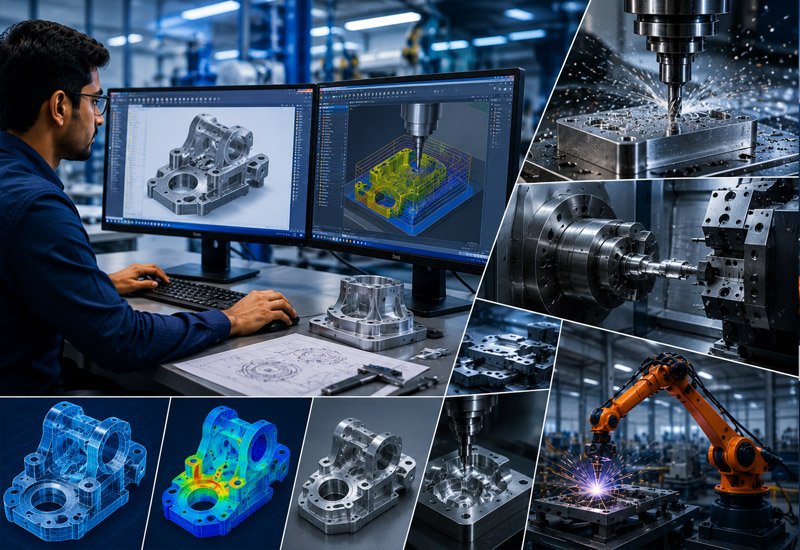
In today’s fast-paced manufacturing landscape, businesses must deliver faster, maintain precision, and control costs. Conventional systems tend to cause delays, mistakes, and inefficiencies. To stay competitive, most companies are embracing CAD/CAM Automation as part of their digital transformation to ensure smooth workflows, high productivity, and higher-quality production across operations.
This innovative design and manufacturing process interlinking helps to lower the number of manual interventions and provide greater accuracy in the information. It guarantees a well-coordinated flow between the stages, enabling manufacturers to work more productively, react faster to changes, and ensure a uniform quality of products at the minimal cost of various production errors.
Understanding CAD and CAM Integration
Modern production systems rely on Computer-Aided Design (CAD) and Computer-Aided Manufacturing (CAM). CAD is used by design engineers to create elaborate digital specifications, whereas CAM translates these specifications into machine commands.
These systems enable manufacturers to:
- Get rid of manual data transfer.
- Reduce human errors.
- Improve workflow efficiency.
- Assure reliable product quality.
The integration guarantees that design intent is incorporated into production without being distorted and enables manufacturers to stay accurate and enhance operational efficiency.
Increased Efficiency and Productivity
In a competitive manufacturing environment, efficiency is important. This is because manual processes usually entail repetitive operations that speed up the production process and cause more errors. Automation, on the other hand, makes work easier through less human involvement and sparks off round-the-clock work processes.
Automation enhances productivity by:
- Streamlining repetitive operations.
- Reducing machine downtime.
- Accelerating production cycles.
- Enhancing workflow management.
It also ensures the efficiency of running machines through lessening the time of idleness, boosting output, and keeping performance consistency without affecting quality.
Enhanced Accuracy and Precision
Precision is essential in manufacturing, especially in industries where even minor deviations can result in product failure or financial loss. Automated systems make sure that all details of a design can be properly carried out in production.
Key accuracy benefits include:
- Direct access to design data.
- Removal of errors during manual interpretation.
- Consistent production outcomes
- Very high repeatability of manufacturing.
Manufacturers enhance machining with optimization of toolpaths and movement, thereby leading to enhanced surface finish, reduced tolerances, and product quality.
Cost Reduction and Resource Optimization
Manufacturers are always in search of ways to cut down their production costs without compromising quality. Automation creates a strategic value by enhancing efficiency and reducing wastage through the production cycle.
Cost-saving advantages:
- Reduced material wastage with design simulations.
- Reduced labor costs
- Reduced errors and rework costs.
- Improved use of equipment.
Using this method will allow the business to identify design weaknesses, prevent expensive process correction, better resource planning, and ultimately increase the sustainability of the operations.
Faster Time-to-Market
Time has become a hallmark of manufacturing achievement. Businesses that are in a position to convert an idea into manufacturing are in a better position to address the needs of the market faster and to beat competition.
Automation speeds up production by:
- Enabling rapid prototyping.
- Allowing rapid design changes.
- Reducing manufacturing delays.
- Improving the general workflow.
With CAM Automation, design modifications are immediately translated into machine code, enabling manufacturers to make rapid revisions and provide quicker delivery of products without any quality loss.
Improved Collaboration and Workflow Integration
Manufacturing is a coordinated effort between designers, engineers, and production staff. The absence of effective integration may lead to delays and inefficiencies.
Integrated systems provide:
- Live access to data on all teams.
- Better interdepartmental communication.
- Published updates within workflows.
- Reduced chances of errors.
Stakeholders operate under one system, and this means there is better coordination and easier running of the project, resulting in high productivity and more dependable results.
Scalability and Flexibility
With the expansion of the business, the business must have systems that can support the demands of production and the needs of personalization. Manual operations may not be very flexible to scale.
Automation enhances scalability by:
- Managing increased volumes of production.
- Flexible response to design changes.
- Supporting custom manufacturing needs.
- Maintaining consistent quality.
Automation enables industries to scale up business without interfering with the current processes, thus it is easier to deal with both small and large-scale production.
Competitive Advantage in the Industry
A highly competitive market requires the use of advanced technology to be ahead of the game. Automation allows manufacturers to enhance performance while minimizing life issues in operations.
The competitive advantages are the following:
- Faster production cycles.
- Improved product quality.
- Reduced operational costs.
- Ability to process complicated designs.
It enables businesses to handle high-precision, complex tasks and stand out to attract new market opportunities.
Future-Proofing Manufacturing Operations
Digital technologies, including AI, IoT, and smart factories, are the future of manufacturing. Automation is a premise for entering into such advances and remaining competitive in the business.
Future-ready benefits:
- Live tracking and performance.
- Data-driven decision-making.
- Smart factory system integration.
- Enhanced operational efficiency.
Investment in CAD CAM Automation will allow manufacturers to keep up with Industry 4.0 trends and secure long-term growth in a swiftly evolving technological environment.
Conclusion
In modern manufacturing, speed, precision, and efficiency are important in order to be competitive. Automation lowers mistakes, boosts production, and simplifies the procedures, which is critical to sustainable development in the modern industrial landscape.
Keyways offers high-technology engineering and automation systems to enable manufacturers to realize greater efficiency and performance. Connect with us on LinkedIn and take your manufacturing to the next level.