


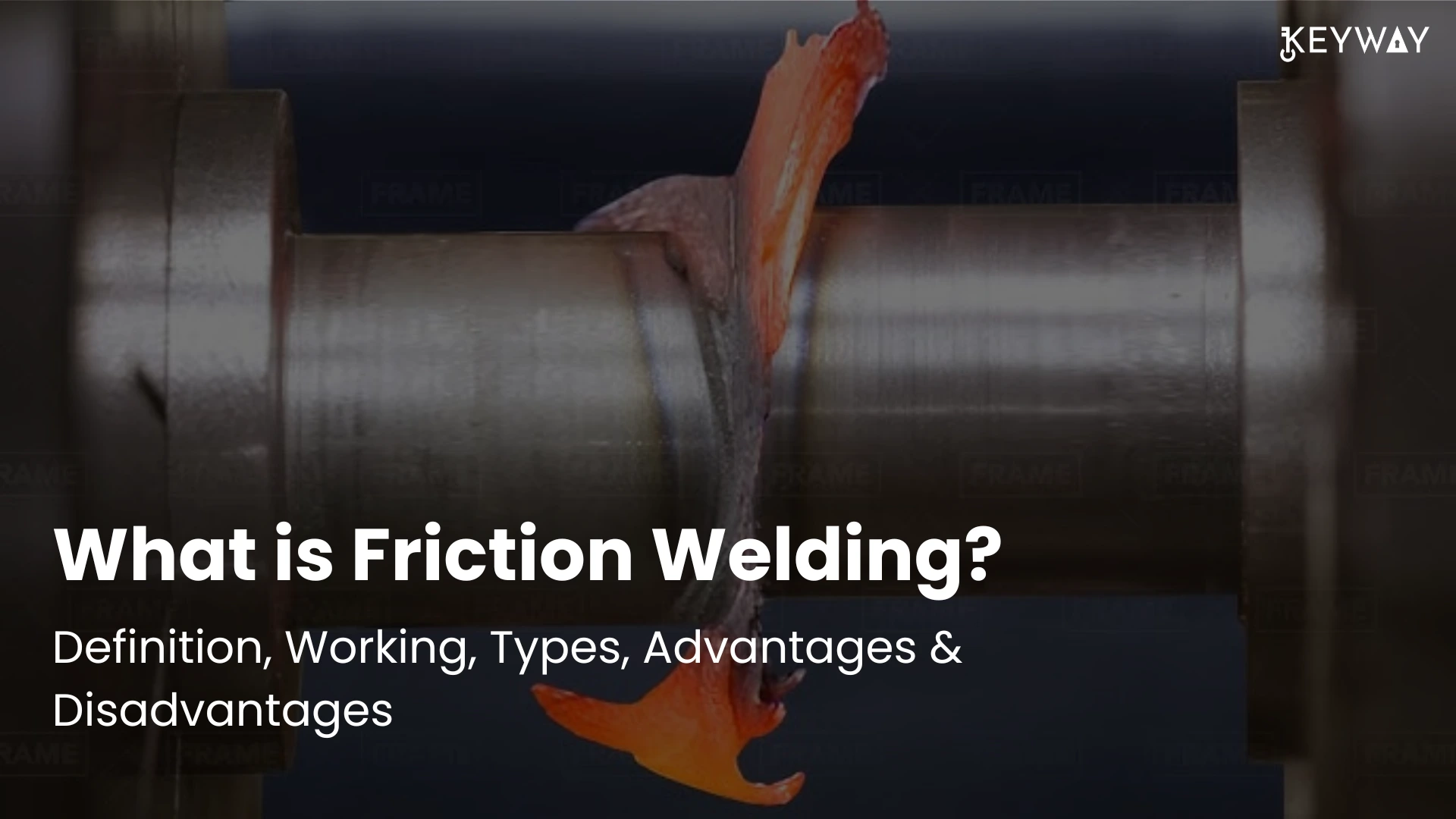
Welding is among the most crucial process in contemporary manufacturing and building, which makes it possible to produce powerful and stable parts that are utilized through industries. Although conventional approaches to welding involve melting of the metals through electric arches or flames, new technology has been developed where the metals do not melt at all. One of such innovative processes is Friction Welding which falls under the Solid State Welding and heat generation occurs as a result of mechanical friction and not by external heat sources.
Friction welding has become well-known in the Manufacturing Engineering and Mechanical Engineering sphere as it allows to create high-quality joints with minimum flaws. It is also of great value in Advanced Manufacturing environment whereby the issue of strength, efficiency and sustainability is of great concern. Automotic Manufacturing, Aerospace Engineering, railways and defence are some of the industries with huge reliance on friction welding in order to achieve high performance expectations.
The blog gives full insight into friction welding, its definition, principle, types, benefits, drawbacks and its use in industries.

Friction Welding – Definition
The friction Welding (FW) is also a solid-state process of join in which the heat is produced through mechanical friction between two workpieces in relative motion. The interface material is softened and not melted as the frictional heat accumulates. When the appropriate amount of heat is obtained, there is a pressure applied on the axial direction, which fuses the two materials to create a powerful metallurgical bond.
Since the base materials do not melt off, friction welding does not have to deal with some of the defects of fusion welding, including porosity, solidification cracks and extreme distortion.
This makes it an ideal solution for producing High Strength Welds and performing Dissimilar Metal Welding, where traditional welding methods often struggle. The absence of filler material, flux, or shielding gas also makes friction welding one of the cleanest and most Energy Efficient Manufacturing processes available today.
⚙️ How Does Friction Welding Work?
The principle of operation of friction welding relies on the transformation of mechanical energy into thermal energy by means of controlled movement and pressure. The workpiece is moved in some manner, either by rotation or by linear motion and the other is immobile. The contact between the surfaces causes friction to give heat at the interface, which renders the material soft at the interface.
When the required temperature is reached, the relative motion will not be considered and the axial force will be applied. It is a force that binds the softened materials together pushing out surface contaminants and oxides of the joint area. The joint is then left to cool under pressure which produces a high density defect-free bond with high mechanical properties. Friction Welding is a highly reliable process that is controlled and repeatable and this feature is very crucial in the settings of Industrial Welding and mass-production.
Friction welding uses rotational or linear motion and axial pressure to join two workpieces. Here’s a basic overview of the process:
Preparation: Two clean workpieces are aligned. One is typically fixed, while the other rotates or oscillates.
Friction Phase: The moving piece creates friction at the interface, generating heat.
Upset Phase: Once the material is softened, relative motion stops, and axial pressure is applied to forge the bond.
Cooling Phase: The newly formed joint is allowed to cool under pressure.
The result? A high-strength, metallurgically bonded joint without melting the base materials.

Types of Friction Welding
Friction welding is not just one process but a set of similar processes, each tailored to various materials, shapes and performance needs. These differences mean that friction welding can be applied in a very broad spectrum of Manufacturing Innovation applications.
It is mostly performed by Rotary Friction Welding (RFW), in which one cylindrical part turns at a high speed with the other part being stationary. When enough heat is produced, the rotation is ceased and pressure is used to finalize the weld. The technique is common in Automotive Manufacturing of items like axles and shafts together with valves because of its speed and repeatability.
Linear Friction Welding (LFW):
It takes the place of rotary movement with a specified back and forth linear movement. The method is best applied in non-cylindrical parts and it finds widespread applications in the Aerospace Engineering field, mostly in the production of turbine blades and blisks. Linear friction welding has an outstanding joint quality and dimensional accuracy.
Friction Stir Welding (FSW)
It is an important innovation in Advanced Manufacturing. Rather than relocating the workpieces, a rotating tool with a profiled pin is pushed into the line of joint and followed along that line. The tool makes the materials mix mechanically so that it creates a solid-state joint. FSW has extensive application in shipbuilding, railways and aerospace structures of aluminium alloys and is considered a standard practice in Energy Efficient Manufacturing.
Orbital Friction Welding
In this welding, the orbital motion is controlled instead of being rotated completely, allowing the distribution of heat at the joint to be uniform. This is an industry-standard technique applied in highly critical aerospace and defense applications where joint repeatability is a significant concern.
Inertia Friction Welding
It is a technique which applies stored kinetic energy stored in a flywheel to create frictional heat. After the flywheel is released, the weld is finished with the help of axial pressure. The technology is well known to manufacture very strong joints and it can be regularly used in the manufacture of high-performance structural parts.
Advantages of Friction Welding
Friction welding has a lot of benefits while compared to many of the traditional methods of fusion welding and is more so better when it comes to high performance engineering.
Key advantages include:
- Defects associated with melting are removed in solid-state process.
- Manufactures joints of high mechanical strength.
- Best in Dissimilar Metal Welding.
- No filler metals, flux or shielding gases needed.
- Ecologically positive process.
- Short cycle times that could be used in large scale production.
- Less energy usage than arc welding.
These advantages are the reason why friction welding is being embraced in the Advanced Welding and Manufacturing Engineering settings.
Disadvantages of Friction Welding
Even though it has numerous advantages, there are also some drawbacks of friction welding, which should be taken into account when choosing a process.
Major limitations include:
- Expensive start up and installation.
- Demand of special equipment.
- Constrained in terms of comparatively simple joint geometries.
- Not compatible with large or complicated assemblies.
- After exact surface preparation and adjustment were required.
These constraints contribute to enabling manufacturers to decide on the suitability of friction welding to a particular Industrial Welding use.
Applications of Friction Welding
Friction welding is also common in any industry where strength, reliability and precision is a must. Primarily it is applied in Automotive Manufacturing in the drive shafts, steering columns and transmission parts. The Aerospace Engineering industry has to use friction welding to make turbine blades, fuel system components and structural components when failure is not a choice.
Friction welding is applied in the railway industry to join the axles, wheels and gear shafts. It is used in the oil and gas industry in drill bits, casings and high pressure valves. Friction welding is used in electronics, which allows copper and aluminium to be connected with high reliability in heat sinks and connectors. Weapon system and armoured components are used in defense and this features the role of friction welding in High Strength Welds and Manufacturing Innovation.

Final Thoughts
Friction welding is a clean, efficient and reliable process of joining that is very critical in the current Advanced Manufacturing. It removes melting and minimizes energy usage, thus providing high-quality joints and promoting the sustainability agenda. Its capability to unite unlike metals in creating non-defective welds renders it essential in performance and innovation-oriented industries.
With changing times and advancing technology, lightweight construction designs and sustainability will continue to be paramount in the industry and lightweight products even as friction welding will persist as the foundation of the Industrial Welding and Future of Manufacturing.