


The 3D reverse engineering is a revolution for manufacturers and engineers. This process works by scanning a physical object to capture its exact shape as it is and recreate it in digital formats in case of missing CAD files or the wear out of parts. Guesswork and re-invention are eliminated, and you receive high-resolution CAD files, which can be fine-tuned and sent to the factory.
This blog describes the process of 3D reverse engineering part re-creation (without original CADs) in detail, providing an insight into the actual advantages to your part of the workflow.
Why You Need 3D Reverse Engineering?
Lost CAD files are very frequent. Vacant parts of old machines, out-of-supply parts, or unsaved prototypes of custom parts plunge stores into stalemates. Conventional tools, such as calipers, require days to measure, and they too give errors.
This is reversed in 3D reverse engineering, in which lasers or structured light are used to scan the actual part. It produces a digital twin within 0.05 mm or more. It is applicable to any item, including engine blocks and medical implants, and it saves time and cost, along with perfect fits.
Step-By-Step Process To Recreate Parts
It is a simple procedure and is based on professional 3D scanners and programs. It can be done in six
straightforward steps, as a proven workflow does.
Step 1: Prepare The Physical Part
Wipe the part down to clean it of dirt, grease, or paint, which can cause havoc with the scan. On shiny or dark surfaces, use a temporary spray to make them appear matte, such as AESUB scanning spray – it evaporates, and it leaves no trace. Delicate components are to be handled cautiously and placed on a turntable. This preparation takes minutes, and it guarantees purposeful data collection.
Step 2: 3D Scan The Object
A 3D scanner such as the Artec Eva or Creaform HandySCAN can be used. These types of devices project lasers or patterns onto the part and record the millions of surface points at all angles. Roll the piece or rotate the scanner around the piece to ensure it is covered completely, including holes and undercuts. The result? An XYZ point cloud file of all the details, which is raw.
Step 3: Clean And Process The Point Cloud
The scan data is imported into software such as Autodesk ReCap or FARO Scene. Either eliminate noise, outliers, or additional points on the reflection. Align several scans in case there were several passes. This step filters the data to a concrete basis, usually compressing file size by half, but still retaining high accuracy.
Step 4: Create A 3D Mesh Model
Transform the point cloud into a mesh with applications such as Geomagic Wrap or MeshLab. This shapes a polygon surface (STL file) which resembles the skin of the part. Improve the mesh and smooth out irregularities and minor holes. Your next step is a watertight digital model, which is now ready to take the next step. Keyways offers you the most reliable of all reverse engineering services.
Step 5: Build The CAD Model
This is where magic happens. Bring the mesh into CAD software such as SolidWorks, Fusion 360, or Siemens NX. Engineers follow some major features: sketch cross-sections, extrude surfaces as well, and add fillets or chamfers. Parametric modeling provides the ability to edit dimensions, tolerances, and features with ease. The resulting CAD file (STEP or IGES) can be completely edited, compared to the scan mesh.
Step 6: Check, Model, And Manufacture
Comparison of new and old scans with deviation color map – green is a perfect match, red has some adjustments to be made. Stress or fit on Ansys or SolidWorks Simulation. Export to a CNC machine, 3D print, or even mold. Test a prototype by printing it; it must be the same as the original.
Tools And Software You Need
● Scanners: Entry-level scanners such as Einscan are used in small shops; pro scanners such as ZEISS are used in high precision work.
● Software: Free ones, such as MeshLab, to work with basics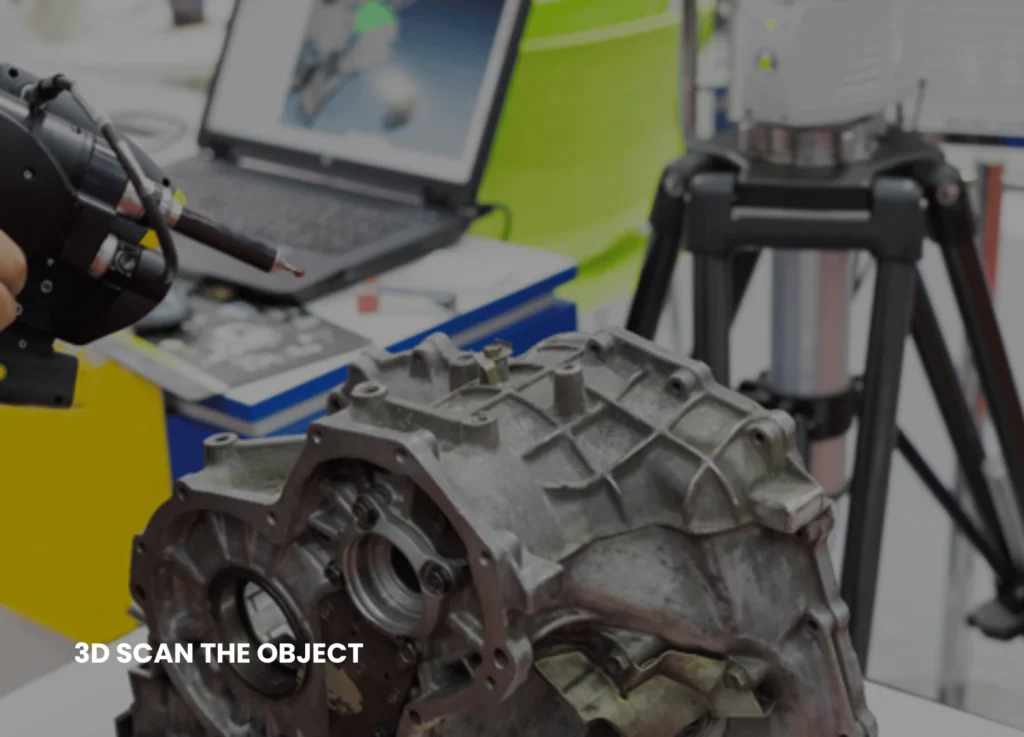 ; paid such as PowerInspect, to do inspection.
● CAD Programs: Fusion 360 (cloud-based, cheap) or CATIA for intricate parts. The prices begin at $1,000 to install a basic set-up, and services provide scans at a cost of $100-500 each part.
Real-World Benefits And Examples
The reverse engineering Shops with 3D cut down the recreation time, which was previously weeks to days. A 48-hour project by one car company saw it recreate a rare gearbox component, saving it a downtime of $10,000.
Aerospace manufacturers do not redesign new turbine blades; they just modify old ones to better alloys. The medical device manufacturers recreate custom prosthetics exactly. Benefits include:
● 90% faster than manual methods
● Tolerance accuracy under 0.1 mm
● Improvements to the files can be made.
● Less scrap and rework
● Scalable to one-offs, batches.
Common Challenges And Fixes
Organic forms, such as castings, may be difficult because of free-form surfaces. Photogrammetry Solution:
Use hybrid scanning on large parts.
Freezing scans? Scan in a non-vibratory controlled environment. Software glitches? Always back up raw data. In internal features, CT scanning is recommended – it will peek inside without cutting the part.
When To Use 3D Reverse Engineering Services
Perfect for:
➔ Making outdated equipment serviceable.
➔ Special upgrades or customisations.
➔ Comparison of quality control.
➔ Competitor analysis (legally) or patent work.
➔ Field samples Rapid prototyping.
It is not the best choice in super-simple components where a caliper is enough, but it is the best for complex
geometries.
Future Trends In 3D Reverse Engineering
Artificial intelligence is making it faster – programs automatically convert meshes to CAD with 95 percent precision. Portable scanners are also used with AR to do work on-site. Cloud-based services enable members to work all over the world. When prices are falling, even hobbyists are using it, but professionals get the advantage in production. 3D reverse engineering services convert used components to new CADs with ease. Meshing, scanning, and modelling give you a replica of everything with no originals, increasing productivity and creativity. Buy a simple scanner and watch your shop change, it’s like you lost your headaches over lost files. Keyways offers you the most unparalleled proficiency in bringing innovation to prototypes and existing products through 3D reverse engineering. To know more about the business, visit our LinkedIn.